Monday, December 14, 2015

From homeschooled farm kid to chemistry grad student

It has been just about seven years since my last blog post. I had actually mostly forgotten about this blog until I was recently looking at nature photos I took as a young teenager. Seeing a photo of a duck entitled "blog banner" made me want to look at this blog again.

Seeing all of the photos were now grey boxes with question marks, I signed in to see about getting the old photos back. That's when I saw the statistics box on the home page that I expected to be flat-lined, but was pleasantly surprised to see there had been 22 page views the previous day, 88 the previous month, and almost 7000 total since the blog was created. Obviously these aren't the most impressive of numbers, but this made me think. Anybody who reads this blog, be it yesterday or 8 years ago, have no idea what happened to the dorky farm kid who liked taking pictures and writing about science.

The short story: I am now in my second year of graduate school in the chemistry department at Colorado State University. How I went from a 14-year-old who thought she was going to be a zoologist to working in a chemistry lab? That's a longer story.

I first started this blog when my mom suggested I share with the world how much I enjoy learning about science and how I used the farm to do it. It also gave me the opportunity to share my wildlife photography, something else I was extremely passionate about. I had a blast with the blog and was getting positive feedback from any friends who read it and received some very nice comments from annonymous readers on the interwebs. I stopped writing when I was 15 and started attending the local community college. My dad worked there and I wanted to start learning science in a classroom. Starting off with Spanish, English, and a plant biology course, I discovered that I had quite a diverse range of interests. When I took general biology, I liked every aspect of it, from photosynthesis and biochemistry to bacteria and ecology. Unlike most of my peers, I really enjoyed dissecting animals and my biology professor complimented my steady hands. I told her it wasn't my first time (referring to my blog post, Canis latran strikes again) and she mentioned that I would probably make a good pathologist. At that point, I decided I was going to do the pre-med route, go to medical school, and become a clinical or forensic pathologist. As with any biology route, I had to take general and organic chemistry. All of my peers had warned me about having to "suffer" through chemistry courses in order to get into medical school, but I actually really enjoyed chemistry. I remember the moment I realized how cool chemistry was in the first lab I attended. I came to the realization that Sharpie markers were "permanent" because it was hydrophobic, i.e. "doesn't mix with water." Therefore, to get rid of Sharpie, you use a high percentage alcohol solution. How cool was that??

I had to move on from the community college though, so I transferred to the University of Illinois in Urbana-Champaign to complete my B.S. in Molecular and Cellular Biology. It was a rough transition. Everyone I was meeting in the MCB program were pre-med as well, but they had a very different take of science than I did. Most of them didn't like science to the degree that I did, and many of them just wanted to go to medical school for the high salary. Going to an informational seminar about undergrad research also made me think about how cool being a researcher sounded. I talked to an academic adviser about doing an MD/PhD program.
"Now why on earth would you want to suffer through that?" he asked.
"Well I want to do pathological research."
"Ooooor you could drop the MD and just get a PhD. You can do research on whatever you want and it'll take less time."
Well that sounded pretty brilliant to me. Because I liked chemistry so much, I was thinking about doing a PhD in biochemistry. While doing my research on PhD programs, I also discovered that you could get a PhD in chemistry with a specialty in Chemical Biology. I wasn't doing very well in the molecular biology class I was currently taking and feared getting a "C," so I decided to drop that course. At the beginning of spring semester, I changed my major to chemistry. I got an undergraduate research position in a bioanalytical chemistry lab headed by principal investigator Jonathan Sweedler. I loved the research I was doing with deciphering neuropeptide function using the California Sea Hare through behavioral and electrophysiology experiments.

I started to get tired of school and was contemplating getting a job with a bachelor’s degree. However, over the summer when I presented a research poster at an undergraduate research symposium, I talked to Jonathan. During the conversation he asked about grad school and when I told him I was questioning going, he told me that he thought I would thrive in a graduate school environment. Getting a compliment like that from a nationally known analytical chemist really gave me the boost I needed to get through my senior year and apply to a few graduate schools.

In January, I heard from Colorado State University about getting accepted into their PhD program, which had to be one of the happiest moments of my life. I went on to write a senior thesis and graduated with high distinction from the department and was also one of four undergraduates to receive an award at graduation, thanks to Jonathan's nomination.

I'd be lying if I said graduate school isn't hard sometimes, but I am still thoroughly enjoying it. I have joined another great bioanlaytical lab with another wonderful adviser, Chuck Henry. My research revolves around designing and fabricating inexpensive and portable diagnostics for infectious diseases.

I successfully completed my first year and am done with classes and cumulative examinations. At the end of this next February, I will be taking my preliminary oral examination. For those of you who don't know much about the PhD process, this is pretty much the doom of all grad students where you present on the research you've done and are going to do. The terrible part is when your graduate committee starts questioning you for 1-2 1/2 hours on your research and the chemistry behind it.
A female sage-grouse (Centrocercus urophasianus)
photographed on a hike in Roosevelt National Forest.

It's still weird to think that seven years ago I thought I was going to be a zoologist and now I work in a chemistry lab. However, I am still doing research and am planning to get a PhD, even if it's a different field. I could theoretically still get a job that involves zoology. My current goal is to get a job at the Fort Collins branch of the Centers for Disease Control and Prevention where they study vector-borne diseases, such as West Nile Virus and Lyme disease.

I am definitely still that dorky little teenager I was back then. Whenever I go on hikes with friends, I bring a camera and will often go all nerdy when I see an animal I know. "That's a cormorant!" I yelled excitedly one day when we went swimming in the local reservoir. "We have those in Illinois! You see how it's sunning itself? That's because their feathers aren't waterproof so that it's easier to stay underwater."

It's no question that it's because of the farm that made me who I am today. Before we moved out to the country, my mom says I was the girliest girl I could be who refused to wear nothing but dresses. Had we not moved to the farm, I likely would not have gotten into science, nonetheless start a science blog. Obviously not everyone who lives on a farm is going to become a scientist. My brother, who had the exact same childhood, is currently in his senior year of a theater program. 

STEM (Science, technology, engineering, and mathematics) is a growing field that will always need people. Therefore it is important we get kids into science at a young age and the easiest way to do this is get outside. You don't need a farm to do this with the county, state, and national parks that are open to the public. Children are naturally curious creatures, so when they ask questions, answer them! Even if you don't know the answer, Google them when you get home. While taking an English class in college, I wrote a research paper on getting kids outside. During my research, I found a research paper from Europe that showed a correlation with students’ outdoor experiences and their success with science in the classroom. 

If not just for a student's interest in science, it's important to get kids outside for the sake of appreciating nature. After all, they are the coming generation, and if the next generation doesn't appreciate nature, what will happen to the world around us? 

Friday, January 2, 2009

Odocoileus virginianus

When walking around in the woods this fall, taking pictures, the sight of a skull sitting in the dirt, caught my eye. At closer examination, I immediately identified it as the Odocoileus virginianus, also known as the White Tailed Deer. I also noticed nearby that there were what looked like a few ribs. Within minutes of searching the area, I had found two almost complete legs, the full back and neck vertebrae, the skull and both jaw bones, the hip joint, both shoulder-blades, and a couple dozen ribs. After finding a clear spot, I started assembling the parts, with the help of an illustration of a deer skeleton, and discovered that I had a nearly complete female deer skeleton that I decided to name Ginny.

I've found parts of deer skeletons before, but they were hardly worth trying to collect, considering how damaged they were. What was unique about this skeleton, was that it seemed to have hardly been touched. Except for the fact that two whole legs, and the tail vertebrae, were missing, this skeleton was perfect. Nothing had been obviously chewed on. Last March, I came across a doe that had been attacked and partcially eaten by coyotes (as proven by the dozens of coyote prints found nearby). I kept a close eye on the carrion, and within a week, all of the meat had been stripped from its body. The skeleton was full, but about every bone on it (including the skull) had been knawed on. How this skeleton somehow avoided complete mutilation is beyond me.

An interesting fact that I learned when searching online for an illustration of a deer skeleton, was that with the way that deers are constructed, they are literally standing on their toe nails. For those of you that aren't familiar with the bones of the human body, the bone in your thigh is the femur, the bones in your shin are the tibia and fibula, and the bones in your feet are the meta- tarsals. As seen by this graph of Ginny, the deer's metatarsals are actually located in the leg. This means the ankle are their toes, and the hooves are their toenails. As demonstrated by the deer's incredible ability to run and jump and incredible speed, their unique structure has been a huge success.
I took this picture in the fall of 2006.

Wednesday, September 10, 2008

Phalacrocorax auritus

"That's not one of our ducks, is it?" my mom asked at lunch this afternoon. I twisted around and saw the waterfowl and screamed, "It's a loon!" I jumped to my feet and grabbed the camera. My movement must have caught the bird's attention since I was only able to take two pictures before it took off. I flipped open my bird guide and went to the loon section. Then I found out that it wasn't a loon, but a Double-crested Cormorant (Phalacrocorax auritus).

The cormorant family, Phalacrocorax, comes from the Greek words, phalakros, meaning "bald" and korax, which means "crow." Then the separate species name, auritus, means "eared" which refers to its crests. So Phalacrocorax auritus pretty much means "bald eared crow."

The cormorant, I have discovered, is an amazing, specially built diving-bird. Sealing its nostrils, the bird can dive up to 30 feet deep and stay down for up to 70 seconds as it preys on fish and amphibians with its excellent underwater eyesight. Another extremely unique thing about this bird is that unlike ducks and other waterfowl, the cormorant doesn't have oil-glands. Oil-glands are on most waterfowl's feathers to make them waterproof. Without these special glands, the cormorants lack buoyancy which allows them to stay underwater longer than most birds. Since the cormorant isn't naturally waterproof, the bird has to spread out its wings in the sun to allow itself to dry after each swim.

Tuesday, March 4, 2008

Just how smart are they?

"Sheep are dumb." recalls Rex, the border collie in 1995's "Babe." Research has proven otherwise, as well as my personal experience.

The picture here shows sheep crossing the most shallow area of a flooded pasture. My brother had come inside one afternoon after a downpour and told us that the sheep were trapped on a newly formed island in the pasture (the sheep pasture is quite hilly making it easy to form islands in floods). We went out there totally in rescue mode, but the minute we walked into the pasture, they went right to the edge and crossed the ankle-deep water. But why do they do this as soon as my mom and I walk in, as opposed to when they saw my brother? In the March 2008 issue of National Geographic, the cover story was of animal intelligence. One of the animals featured was sheep, and they mentioned that the animal can remember faces for months and even years. My guess? When the saw me, a.k.a. Hay Girl, they thought it was feeding time.

One of our new additions this year was an English Shepherd puppy, Porter, a puppy we hope will make herding the sheep into the barn for shearing easier. Each year it has been harder and taken longer to get our sheep in for shearing (in case you haven't guessed, sheep don't appreciate being sat on their butt and having their wool cut off). Our first year with only 6 sheep was very simple. Take out the pan of grain, shake it, and they came running faster than a coyote on a rabbit. Did it work the second year? Nope. The next couple years, we were using hay, grain, noise, anything. But each year, it was just getting harder and harder. Last year was, by far, the hardest. We always start early in the morning long before the shearer is due to arrive. There's a single pasture standing between the sheep pasture and the barn. So our first goal is always to get them in the next pasture. This year, we had been out there for over an hour trying to use grain, hay, and medal feed pans to herd them into the next pasture. Sheep are scared to death of dogs, so we got the brilliant idea to put our well trained obedience dog, Addy, to sit and block one side of the pasture. That made it much easier, and we finally got them into the next pasture. Next, we had to get them into the barn. We did the exact same thing with Addy. Addy was sitting quite still on one side of the pasture for blocking and the sheep didn't go near her, but neither did they go near the barn. Then after ten minutes, one single sheep went past Addy. That was when the sheep learned that she was not going to attack them, so Addy was no longer usable. We ended up catching each sheep one-by-one and putting them in the barn.

As you can see, the main key to the intelligence of the sheep, is memory. They remembered the face of the hay girl and thought it was food time. They remembered that when the two-leggers try to get them into the barn, they were going to be trapped in a stall, sheered, and de-wormed, and their hooves would be trimmed.

Now when it comes to goats, the farm animal that I'm most experienced with, their key to intelligence comes from the old saying, "Monkey see, monkey do."

We once had a male goat when we first moved here named Bucky. Of course, you can't have a male goat with the female goats. Otherwise you'll have lots of little baby goats running around. When we built him a separate pen, we mistakenly put the lock on his side of the gate. It was a typical lift-and-slide lock. Only a few days after locking him up, we looked out the window to see that he was out and about. When we brought him back to his pen, we saw that the gate was wide open as if someone had let him out. We shrugged it off and assumed that someone had forgotten to lock the gate. But alas, twenty minutes later, the buck was happily chasing after the female goats. Angrily, we grab the buck and drag him back to his pen to see that the gate was once again wide open. This time, we knew no one forgotten to lock it. We put him back in his pen, took a few steps back, and waited. Not shy about showing his technique, he happily walked up to the gate, lifted and slid the lock before pushing the gate open to victory. No problem. Just put a U-shaped nail in the lock. That way he won't be able to lift and slide. Wrong again. Ten minutes later, he was once again chasing the girls. And again, the gate was wide open with the nail lying on the ground. We locked him up again and he simply knocked the nail out before doing the same routine. The only reason we beat the buck at his own game was because he didn't have thumbs. We put a clip on the lock, and he didn't get out. Similar thing happened with our LaMancha doe, Muse. She figured out how to unlock the milking stanchion when she was done eating but we weren't done milking.

So sheep use their memory, and goats use the whole "monkey see, monkey do" factor. But are there animals that are naturally intelligent or instinctive?

The pigs, Blackberry and Top Notch were the ones that made me really think about animal intelligence. When discovering that Blackberry was pregnant, we saw that they were out of straw in their shelter. So the next chore time, I brought a bale of straw out and broke it open. I started breaking apart the flakes and tossing it into the shelter when the two pigs came over and started grabbing the straw themselves. "No, that's not food -- that's bedding!" I cried out at first. But then they walked into their shelter and tossed it to the back. I stared agog as they were spreading their own straw. The next morning, I peeked in the shelter to see that they had constructed a perfect and warm nest.

Even chickens are more intelligent than they appear. When catching chickens for butchering one summer, we came across a very intelligent cream rooster. It was dusk, so it was getting harder for us to see as we were catching the roosters. Their chicken house was right next to the woods, and that's where the remaining roosters were fleeing to. With two people, usually it's much easier and faster to catch chickens. Another thing is that poultry always run to avoid getting caught. Although chickens only reach 9 MPH, they make turns much faster and easier than people, and they don't get tired easily. The last rooster was fleeing into the woods, and the sun had almost disappeared behind the trees. When we got onto the steep hill by the creek, we couldn't locate the rooster anywhere. So we also opened our ears. We didn't hear anything -- no crushing of grass, panting, or making any animal communication. When passing a fallen down tree, I got the smallest glimpse of white. I turned and couldn't help but to let my mouth fall open when I saw that the chicken was under the log and had completely shoved himself under dead grass and sticks, making himself almost invisible. I walked up to the rooster, half expecting him to make a run for it. But he never moved until I grabbed him. If I were any old coyote or fox, I bet they would have never found him.

The intelligence of animals in this article is only based upon my own personal experience, and with farm animals that aren't considered the smartest. There's a lot of information on animal intelligence in exotic animals in the March 2008 issue of National Geographic.

I'm sure you've had experiences with your own household pets on intelligent. Care to share?

Monday, November 19, 2007

Never Mess With Nature's Plan


I was talking to a friend a few years back, and when I mentioned hunting season, she gave a great groan and asked "What's the point of killing innocent deer? It's just another one of those disgusting sports, isn't it?" Prior to that day, I hadn't really thought about why hunting season was necessary.

In my "Bug Eating Heroes" blog entry, I mentioned that if bats were killed off, the bug population would explode. I also mentioned that it's the same with sharks keeping control of the seal population. If we continue to kill bats because they're "dirty" and sharks because they're "vicious man eaters", we'd have to make an annual "Bug Hunting Season" and "Seal Hunting Season." It sounds ridiculous, but I'm sure people a hundred years ago would've laughed at the thought of a "Deer Hunting Season." We had already made the mistake with the wolf and cougar population. Since wolves (Canis lupis) and cougars (Puma concolor) were killing livestock and on rare occasions attacking humans (only true with Cougars), they decided to kill them near extinction thinking that it was the right choice for everybody. However, without a natural predator, the white tailed deer (Odocoileus virginianus) population exploded leaving us no choice but to hunt them ourselves.

But is deer hunting really that necessary? We learned just how necessary it is this year. Hunting season is split up into two weekends in November. However, last fall, hunting season was cut short when we had a weekend long blizzard in Illinois, so of course no one hunted. Sure, no big deal that only half of the deer got killed last season. Well this spring, it was near impossible to go down the road without nearly hitting a deer. And for the first time ever, we had deer in our garden. We went out there one morning to see that all of our pepper and tomato plants had been eaten to the roots, and our corn was mostly eaten. I assume they went for our garden as opposed to the corn field across the road because we grow organic sweet corn as opposed to sprayed cow feed. The corn had recovered and produced plenty of delicious corn just to be mostly destroyed by the deer again.

In Halloween 2005, my family rented the movie, "Night of the Lepus." Just by the sound of it, you can tell that it's another cheesy 70's horror flick. As stupid as this movie is, it does touch on the whole Never Mess With Nature's Plan. A local rancher is friends with a lab scientist and when he has trouble with coyotes, the scientist develops a chemical that destroys the wild dog population. But with no coyotes, the rabbit population gets out of control. When the rancher goes to the same scientist for another cure, the scientist comes up with a germ that should destroy that population too. Since it was a germ, when the rabbit was released back into the wild, the germ spread to the other rabbits. But the germ doesn't kill the rabbit population (shocker), instead it turns them to the size of wolves and makes them go carnivorous.

In the 1980's, the aphids were starting to get out of control, so we decided to bring in the Asian Ladybugs (Harmonia axyridis). They took care of our aphids problem but left us with another problem, them. The Asian Ladybugs are also nicknamed the Halloween Ladybug since they invade our homes in October in preparation for winter. In my family... and pretty much all of my friends' families, this time is nicknamed "Ladybug Season." The most dreaded season. Since the Asian Ladybug is not native to our country and has no natural predator, so they're invading the country with no control.

So in case a wolf gets one of your calves, or bats creep you out, don't go doing anything crazy like annihilating the species or bringing in another species to do it. Before doing anything crazy, you always have to look at both sides. Sure, a cougar took down your favorite cow, and the same thing happened to your friend. But you can't just decide that cougars are no use, that they're just dangerous. You really have to think of what the animal does for our earth. A hundred years ago, farmers thought wolves were a nuisance when really they were keeping the deer population balanced. Do the earth a favor, and really think about nature's plan.

Wednesday, October 31, 2007

Ah, autumn

Fall is one of the most relaxing seasons -- and most beautiful. It's definitely the best time for squirrel watching and photographing since there are so many squirrels gathering nuts for winter. Deer are extra shy because hunting season is coming up. It is time for raking leaves into piles so you can just jump into them afterward, for wearing jeans and light jackets. All of the maple trees are turning colors varying from bright yellow to blood red.

Why do leaves change colors anyway? Someone asked the same question in the October 2006 issue of Ranger Rick. In spring and summer, trees use chlorophyll to make their food. It also gives leaves their green color. When fall comes, the trees begin to close down their food-making systems. At the same time, they start living on the stored food they've already created. The chlorophyll disappears from their leaves. When the green fades away, you can see the other colors. Some colors, like yellow and orange (specifically maples change to these colors) have been there all along. Others usually change to brown in the fall.

This fall, I'm seeing something that I've never seen before. A blue jay (Cyanocitta cristata) collecting for winter. It took my family and I only days to figure it out. It was odd when we would sit down for breakfast or lunch and see a blue jay flying by the back deck every five to ten minutes. I discovered that it was going between the trees in the front yard too. But specifically, it was obviously gathering in the Shagbark Hickory tree twenty feet from my bedroom window. Looking at them closely through binoculars, they're going for the hickory nuts. They peck at them until they fall to the ground. Blue jays are beautiful sky ornaments. But their call is a dreadful one. I figured out that the very distractive screeching call came from the blue jay a few months ago when I saw it cawing in one of the pasture's trees. Here's a sample from All Birds. They're actually pretty aggressive birds. Especially a female nesting. If a human goes anywhere near a female's nest, the blue jay is actually known for attacking the two-legger. If a bird roosts anywhere near the nest, the blue jay will attack it until it chooses another place to roost. Its personality is like a crow, right? Then it'll be no surprise to hear that the blue jay is actually part of the Corvidae family which is the same family as the crow. If you look closely to the blue jay's face, you'll see that the crow's beak and the blue jay's beak look almost identical (unfortunately, I don't have a picture of a blue jay since I can't get close enough). It's pretty unbelievable what's under the prettiest feathers.

Tuesday, October 9, 2007

Canis latran Strikes Again

We still have three lambs, thank goodness, but when brushing my teeth before chores this morning, I heard tons of splashing in the pond, and the geese were honking like crazy. They do this just about every day, but today seemed a little louder. I walk over to the open window and started screaming "NOOO!" when I saw a brown coyote just starting to make its escape with a goose as big as itself. I dropped my toothbrush and ran downstairs. My mom was screaming too, I ran on the back deck, to see him disappearing into the woods. So I changed direction and ran out the front door after slipping on my shoes. I ran behind the pond. I didn't see any feathers, so then I ran to the creek to see rings of water that were fading. I ran along the creek, and then I finally saw a couple of feathers on the other side. I ran to the local beaver dam and crossed it. I had lost the trail of feathers and then I saw a feather caught on a thorn bush at the bottom of a hill. I ran up the hill and at the bottom I saw a big tan lump. I ran down the hill to see that it was indeed the goose. I picked it up (it was dead) to see a large puncture wound on its back.

I brought it back to the house, and my mom asked if I wanted to do a necropsy on it to figure out how it died. Something that I've never done before so it should be fun. (If you are easily disgusted, perhaps you shouldn't read on.)

I plucked the area around the wound. There was one large wound about an inch in diameter, and around five other small puncture wounds from its other teeth. There were many little purple bruises. Two long scrapes on each side of the goose's back says that the coyote had trouble getting a grip on it. Since there was one large wound that no longer had feathers around it, the coyote probably stopped to eat it. Then when it heard me coming, it didn't think it was worth it to bring the goose with it, so it left it behind and ran.

I first started cutting from the wound out. There wasn't much bleeding yet, however the spinal cord had quite a few cracks in it. Still, it wouldn't have died from that. I kept cutting wider around the other wounds, but I still didn't find anything obvious that would kill a goose. I gently pulled the skin from the body down toward the ribs to see if anything was up with the ribs. Then my hand slipped right into the goose's body, and I had found the trigger to the goose's death. My fingers were sitting in a puddle of warm blood. I felt around a little bit. My fingers brushed against something sharp and then there was some kind of extremely punctured and bloody organ. I felt toward the sharp thing again and realized that it was a broken rib. In fact, it was many broken ribs. About five or six ribs had collapsed and punctured its lung very severely. Several other ribs were just snapped off at the base, but they hadn't collapsed into the wound.

So the coyote takes a good grab at the goose's back and takes one big chomp. It snaps more than half of its ribs puncturing the lung, causing it to suffocate. It takes off straight for the creek and crosses it. It runs along the creek and then takes a turn for the hills running through a few rose bushes. It gets to the other side of the hill and sets down the dead goose. It's well away from the pond, so it starts to rip apart the meat until it hears a two-legger coming. Already well exhausted from running as fast as it can with a ten pound goose, it decides it's not worth it and runs for its own life.

In high school, kids dissect frogs and worms to find out how they're built. I dissected a goose to figure out a whole crime scene. Wow, I love the country.

Thursday, October 4, 2007

Bug Eating Heroes

Bats are blind. Bats have rabies and attack people. Bats fly into peoples hair. Bats are dirty.

These are all the rumors that people have made up about bats. A lot people see them as terrible creatures that attack people and whatnot. When really, they're very important creatures. Especially to gardeners... and really everyone.

The picture above is a bat skull that we found when cleaning out our barn. As you can tell, it fits perfectly at the tip of my pointer finger. The other picture is the wing of the bat. These are the only two bones that we found, but they're obviously from a bat. The thing that I love about the skull is that it looks just like a coyote or wolf skull, except it's the size of a thimble. Although the wing looks fragile, it's really quite a flexible bone. I would put a picture of bat with the flesh on it, unfortunately, those creatures fly so fast that it's near impossible to get a picture of them.

Probably what got people to start the rumor about them getting caught in people's hair, was when a bat was flying right at them, but the person probably got scared and ran before they could see that they wouldn't get hit. When I was leaning against the barn one time at dusk, I was watching the bats twist and turn and dive and fly. Then a bat swooped down and was coming straight at me, but when it was about six or seven feet away, it immediately flew up. Bats don't catch insects by eyesight (this is not true about bats around the world who feed on fruit). You might have heard of echolocation. Scientists use it to detect things underwater by sending sound waves, and seeing what objects bounce off. Bats let out high frequency sounds that humans can't hear. These sounds bounce off the insects and back to the bats sensitive ears. It also lets them avoid hitting large objects like buildings, trees, and of course, humans, which is how the one I saw didn't hit me. This very successful system, allows them to catch up to 3000 insects a night (including the worst, mosquitoes). This is why more and more people are starting to put up bat houses in their backyard.

People also aren't big on bats because they're often found in people's attics. Of course, it really is quite logical why bats would do this. Bats live in caves during the day. So when they're in an area where there are no caves, they look for places similar to caves. Where better than an open attic? People always creep out and call animal control when this happens, when really all they need to do is wait until the bats leave at dusk for feeding, then secure the hole the bats used.

One of the most common rumors -- bats have rabies and attack people -- is false too. About .05% of bats have rabies, and even if they do, they very rarely attack humans. And about the dirty thing, bats constantly groom themselves. So they're as clean as cats!

Bat watching is always best on summer evenings if you live up north. When the autumn frosts start, bats either hibernate until it's insect season again, or migrate down south. In fact, a tourist attraction in Austin, Texas, is the Congress Avenue Bridge where more than a million bats roost. So at dusk, people start to gather around the bridge, waiting for huge clouds of bats to come out and start hunting!

Gardeners and farmers, especially corn farmers, should be quite thankful for bats. Moths very often lay their eggs on corn, and when the caterpillars hatch, they start feasting and ruining the corn. Bats eat the moths that lay these eggs. So the bats can help prevent farmers' corn from being ruined!

All in all, bats are wonderfully important creatures that should be loved and well protected. If bats became extinct, the corn industry would probably go downhill, and the mosquito population would skyrocket. It's the same thing with sharks. If sharks become extinct, then the seal population with get so high, that the seals would run out of fish to eat, and saltwater fish companies would die.

Three cheers for bats!

Friday, September 28, 2007

Necrophila americana

Last fall when my dad butchered a sheep, he dropped the pelt on top of the head, which he had left under a tree, and he forgot about it. A week later when he was passing by it, he grabbed the pelt, and under it was a perfectly clean sheep skull. Maggots could definitely not work that fast, so I asked a biology teacher who attends our church. He said it sounded like the work of a carrion beetle. After that, any time we came across a dead animal, we would put wool on top (to avoid predators or the domestic dogs finding out) and check on it a week later. I had never seen the creatures doing their work, since whenever I would check on the skeleton, the process was done.

Earlier today I was photographing a squirrel. After I was done, I turned around, walked two steps, and nearly stepped on another squirrel, except it was dead. Covering its opened wounds was the unmistakable American Carrion Beetle (Necrophila americana). These beetles are some of the best beetles for nature. As you can tell by the name, they eat carrion (dead animals). When an animal dies in warm weather, it immediately starts decomposing, releasing a stench that of course attracts flies (specifically, the big shiny green ones, Green Bottle Fly) and all sorts of Carrion and Burying Beetles. Judging by the disturbing view that I saw, they had just started on the squirrel, and they always start in the open areas.

I'm not sure entirely how long it takes for them to take care of certain sized animals. For each of the carcases that I have put out there for them, I would just go out a week later and find a perfect skull that was in need of dusting. For this dead squirrel that I found, I forgot to check on the carcass the next day, so I went out there two days after finding the body, to not find anything. If I had to guess, they finished their work quickly and cleanly, and some wild carnivore took the bones. I'm hoping that one day when I find them again, I can collect them and put them to work on a body in a certain protected area, and I can check on it daily to check out their work.

Carrion and Burying Beetles also help with the fly population. Obviously these beetles can just keep eating and eating. So the maggots that the flies leave on the bodies are competition. When the flies first lay the eggs (if you ever see sawdust looking stuff on something, they're fly eggs), the Carrion Beetles completely ignore them. Then when the maggots hatch and start devouring the meat, the Carrion Beetles start going for them too. I guess flies will just have to lay their eggs on things that Carrion Beetles can't get to.

This was all the information that I could gather on Carrion Beetles. However, if you find more information, please let me know, since I'm sure there's much more to discover!

So if you find a perfectly clean skeleton or skull, I'm sure you have the Carrion Beetles to thank for that!

Tuesday, September 25, 2007

Nematomorpha

When my friend and I were traveling along the creek, we admired all the frogs when she gasped, "What is that?" I looked to where she was pointing to see a a wire looking thing moving around in the shallow waters. We immediately grabbed it and brought it to the house and put it in a clear container full of pond water to get this video. It was probably around five inches long and very wiry. We let it go and immediately start researching. We found what we had discovered was the Nematomorpha (from the Greek nema, "thread," and morphe, "shape") . Commonly known as Horsehair worm or gordian worm.

One look at the worm, and you think it's a parasite. It is. But it's completely harmless to humans and pets. Instead, it's a parasite of insects which makes them helpful for the insect population. The larvae lives in the insects, and when juveniles, they come out and live in the nearest water source. These worms are commonly found in puddles, streams, ponds, water troughs, and even backyard swimming pools. Every so often, they're found in toilets freaking people into thinking they are a human parasite.

Although the one that I had found was only around five inches long, these millimeter thick parasites reach up to one meter long. The reason for their common name "Horsehair Worm" is the rumor that a horse's hair would fall into a water trough and come to life. Their other name "Gordian Worm" came from the way they would bring themselves into a tight knot (the one that I saw did this when I took it out of the water) that specifically looked like a knot that Gordius, king of Phrygia around 330 B.C. used. As the myth goes, Gordius used this knot to bind a chariot to a pole. He declared that whoever could undo the knot would become ruler of Asia. This knot is commonly known as the "Gordian Knot".

Horsehair worms reproduce in spring, early summer, or autumn. Eggs, often numbering in millions, are laid in long strings similar to gelatin. When laid in the water, the incubation may range between 15 and 80 days, depending on water temperature. The mode of development of the worms after hatching is much to question. Some experts suggest that the larvae encyst on vegetation along the water's edge after hatching. Eventually, some of this vegetation is eaten by the insects in which the larvae will feed upon until juvenile. When it emerges, it usually kills the insect (as the way of helping the insect population).

So these creepy tape-worm looking parasites, are really friends to humans. Who would've guessed that these simple creatures are of such interest?

Tuesday, September 4, 2007

Pond Sharks

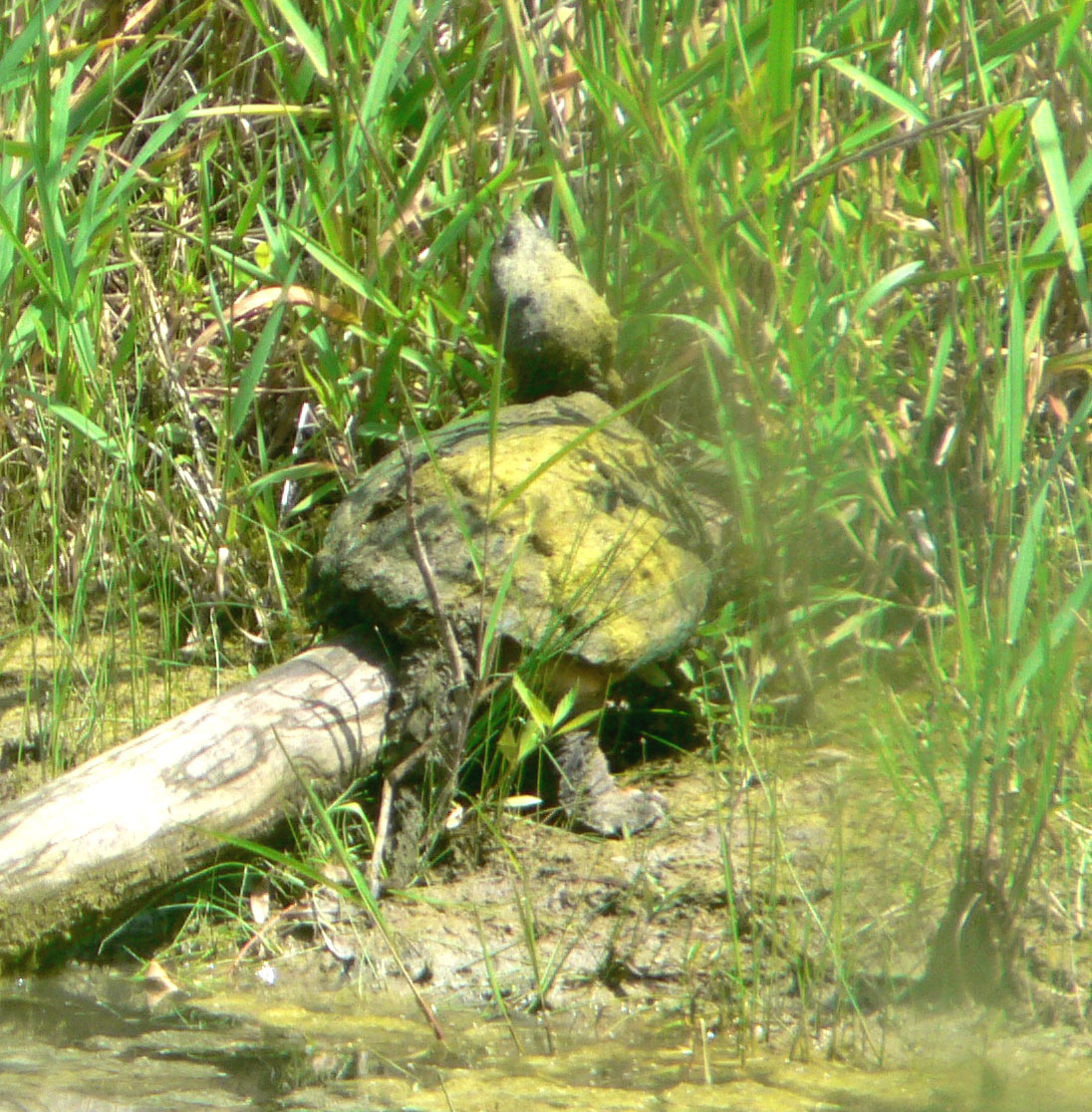
The picture here is of a Common Snapping Turtle (Chelydra serpentina). It was taken almost two months ago when we saw our little pond shark decide to take a sun bath (to avoid scaring it, I did a belly-crawl for a hundred feet). This was the only time we saw the animal on land.

Hearing my mom screaming something outside the door to my dad, I knew it wasn't good. I ran up the stairs to see Mom pointing vigorously out the back door at something. "Something's got the duck!" she screamed. I jumped out the back door and ran to where my dad was just standing by the edge of the pond staring and looking furious. One of our 7 week old ducklings was floating upside down with the flesh stripped from it's neck and a turtle head the size of goose egg disappearing in a mud cloud. "It's that snapper," he mumbled. "Where's your fish net?" Although my fishing net probably couldn't catch something that was 15 pounds and cement jaws, it was worth a shot. I got the net and came back. My dad was still staring at the mass of algae not far from shore. We waited with the net for about twenty minutes. Twice, the same head appeared a couple inches from the surface and bobbed there for a few seconds to check it out. But after that second time, it probably figured that it couldn't finish its duck.

That's just snappers for you. And we wondered where all of our ducklings that our ducks hatched went. Probably just more victims of our pond shark. It's just nature, but it would be nice if they could just go for all of the fish in the pond as opposed to our gorgeous ducks. There's no saying how old the turtle is since all of the resources that I'm finding are saying different things. Some are saying that wild snappers only live to 30 and others are talking around 100. Agreeing with the latter, I'd have to say that this turtle is close to twenty years old.

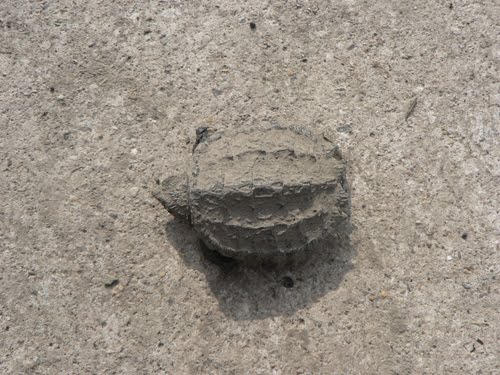
The pictures here are of a baby snapping turtles that are probably around six months old (they hatch in fall). I found this one in a puddle about ten feet away from the creek. I brought it to the house and weighed, measured, and photographed it. The funny thing is that I found another baby snapper two days later taking a swim down the creek. I knew it wasn't the same one though because of its measurements and weights. These two measured 1' in length and width and both around half an ounce. These were definitely not hatchlings since when they first come out of the shell, they're only about the size of a quarter. They had to have been from the same nest, considering they were only 1/8 of an ounce or an inch apart in size. And since we live up north where it's cold, they probably stayed in the nest for the winter, and had just come out for spring. They also looked the exact same, so they had to have been the same sex. I'm not sure how to tell the difference in sexes at that age, but female and male's plastron (under-shell, as pictured above) are slightly different along with their tail as shown in this diagram from Ehponline (scroll down, till you see an illustration with an upside down turtle). You see, just like crocodiles and alligators, the sex determination of the animal is based upon the temperature when they were incubated. Males will hatch if incubated between 22 and 28°C, and females are produced if outside that range of temperature. Considering the crazy weather we've had the past year, it wouldn't surprise me if these were females.

Unfortunately, there's a chance that the turtles that I have caught are already dead. It's very unfortunate to be a turtle. The chance of them surviving to adulthood is very little. The female will lay around 50 eggs, but there's a good chance that a raccoon, coyote, fox, or any other carnivore will dig up the nest before they even have the chance to hatch. Even after hatching, they have to survive without being eaten by large fish, herons, minks, or raccoons. It doesn't really help that it can't curl up in its shell as tight as most turtles can. As you can see, the baby turtle here is trying its best but not succeeding that well.

Well, unless we want all of our ducklings to disappear, we'll have to figure out some way to catch those snappers... without harming them. We still want them in our area, just not in our pond eating our ducks. (We started with 14, now we're down to 8.) Then again, it wouldn't surprise us if the coyotes are helping with those numbers. So if there is a way of catching them, we'll just relocate them to the creek where there are plenty of other snapper friends.

Monday, September 3, 2007

Canis latran


The coyote (Canis latran) is a shy and very common predator. We've only seen them a couple times, and of course we've heard them at night (Canis latran is Latin for barking dog). We've never had trouble with them. They're like wolves and dogs, so of course I've had an interest in them. My liking for them now is plummeting by the day.

It seemed to have changed two weeks ago when we had a solid weekend of rain. The pastures had flooded, the creek had turned into a river, and the river had spread into the sheep pasture. Ophelia's ewe-lamb (the black with white spots on her face) had disappeared. Considering the newly formed river in the sheep pasture, we had all assumed that she had gotten caught in the river and had been washed away. It still didn't make sense though. The rain had stopped and the pastures had gone dry again. Then Minerva's ram-lamb (the black and white spotted) disappeared. This time we knew it wasn't the flood. The only other thing that could've done this was a coyote.

So we examined the pastures and found huge gaps in the electric fence due to holes in the ground. We hung extra electric wire on the fence to fill the gaps. Our guard dog that had been with the goats, we put in the sheep pasture. No lambs were taken for two whole days. Then we saw the dog trotting down the road. Not knowing how he got out, we stuck him in with the goats again. The next morning, we went outside and discovered that two twin rams (the white ones) had gone missing. After fixing the fence so that the guard dog couldn't get out, we put him back in there last night. This morning, we went out there to discover that Majik's ram-lamb (the heavily spotted white, gray, and black) had gone missing.

The odd thing with all of these attacks is that there has never been one speck of blood. Usually when they carry off lambs or kids (baby goats) they leave a trail of blood. But in books and websites, they talk of larger breeds of sheep, and we have Shetland Sheep which is a small sheep (running 50-100 pounds). The lambs can't be more than five to ten pounds. There's a good chance that they just grab hold of the neck of the lamb and take off. Scientists say that coyotes highly respect electric fences. When an animal gets shocked by a fence, they don't try to go between the wires or over the fence because they don't know when the voltage ends. However, local homesteaders are saying that more coyotes are learning that they can simply jump through the fence and even touch the wire, but not get shocked. To get shocked by an electric fence, you have to be grounded. So obviously this coyote (or coyotes, considering we lost two at once) has figured out the simple world of the electric fence.

But why are these coyotes going after our lambs? What's wrong with all of the rodents and rabbits? Are there enough rodents and rabbits? The population of coyotes is steadily increasing for many reasons. The main reason is when female coyotes are stressed, the have more babies, earlier in their life, and more often, according to the December 2004 issue of Ranger Rick.

Another reason is Tyzzer's disease. Tyzzer's is an untreatable disease that is transferred from animal to animal from fecal to mouth contact. It started in laboratory rodents and then it was discovered in Iowa muskrats. It's not rare for them to be found in all laboratory animals worldwide. In many areas, Tyzzer's is making dents in the wild rodent population (muskrats, rabbits, mice, rats, etc.)

Spring comes and rabbits are out and about. We can't go down the road without nearly hitting a rabbit. Usually we'll come across many rabbits. This spring came, and we'd go down the road and we might see a rabbit. We'd go into the woods and every now and then a rabbit would jump out of nowhere and run to the nearest hiding place. But then in May we'd never see rabbits running down the road, or jumping in the path in front of us. Not being a big deal, we just shrugged it off.

We've always had trouble with mice in our milking parlor, but this past spring and summer, not a rodent has bothered us. Our LaMancha goat, Muse, was a bit thinner than normal earlier this summer, so we dewormed her and gave her more grain at milking time. In July, she got diarrhea, so we started give her treatment for Coccidia (a single cell organism that affects animals like a parasite). One morning, I went out there with a milk bucket and when I milked her, she had no milk. Maybe two drops. The previous night, she seemed a bit low, but we just assumed she hadn't gotten enough to drink. I told my mom that she was dry, but she wouldn't believe it. A goat cannot dry up in less than 24 hours. The following evening when I was bringing in the goats, I heard Muse letting out muffled screams from the goat shelter. I ran in there to see that she was having convulsions and was foaming at the mouth while screaming with her two kids standing next to her staring at me as if saying, "Can't you do anything?" I ran to get help and we carried her into the barn, and ten minutes later she died. With such an unexpected death, we brought her to the local vet for an autopsy and a week later, they called and said it was Tyzzer's. They had never heard of it being in a goat. We immediately started researching this mysterious disease. It took a couple days for us to put two and two together, but we finally realized this was why we hadn't had mice in our milking parlor or rabbits running down the road.

So the wild rodents get Tyzzer's and die, and the coyotes have no food. I'm surprised they didn't discover our buffet sooner. The only thing we can come up with is that the flood drove them over here and they discovered that they have five pound meals right in front of them. Our only option is to move the sheep. As soon as they have all of our lambs, they're gonna start going for the adults too. We'll figure out something... and hopefully the rodent population will go up again.